The jobs that go first
I want to know which jobs stop making economic sense to pay a person to do.
Start with work where the person isn't the point. Move the pallet. Enter the record. Check the document. Pack the box. Deliver a correct result, at the required speed, for less money.
Leave out work whose value depends on a necessary human relationship, personal care, or human touch. This article also leaves out meatpacking. The question here is narrower: where is substitution strongest, what does it actually cost, and what stops it?
The unit is a completed task at an acceptable quality. A robot arm's sticker price and a model's token price are inputs. Neither is the price of replacing an employee.
My clock: what I need to do next
I can't know the date my opportunity closes. I can set a pace that gets me useful before the next two hiring cycles. The race is against firms learning to get the same output from smaller teams, including teams designing and deploying robots.
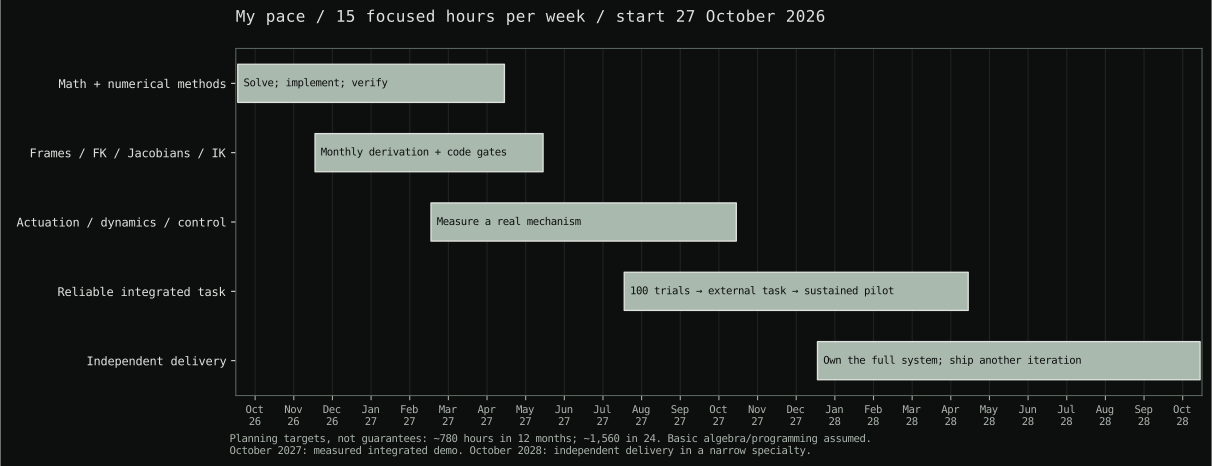
Start now. Budget 15 focused hours a week: six solving math problems, six building and debugging, three studying and reviewing failures. That's roughly 780 hours in a year and 1,560 in two. This is a planning budget, not a measured guarantee of expertise. It assumes basic algebra and programming; use the first week to check those prerequisites.
| Deadline | What I should be able to demonstrate |
|---|---|
| November 2026 | Solve small linear systems; use vectors, dot/cross products, units, and trigonometry in code. |
| December 2026 | Differentiate and integrate basic motion equations; explain velocity, acceleration, and numerical error. |
| January 2027 | Compose and invert coordinate transforms; move a point correctly between robot frames. |
| February 2027 | Derive and implement forward kinematics for a simple arm; check against simulation. |
| March 2027 | Derive a Jacobian; identify singularities; verify derivatives numerically. |
| April 2027 | Implement numerical inverse kinematics with joint limits and explicit failure cases. |
| May 2027 | Generate bounded velocity/acceleration trajectories and execute them in simulation. |
| June 2027 | Read encoders, command an actuator, and log position tracking with limits and a working stop. |
| July 2027 | Tune a position-control loop and measure error, overshoot, and disturbance recovery. |
| August 2027 | Estimate torque, gearing, inertia, power, and thermal requirements for a real load. |
| September 2027 | Calibrate frames and sensors; measure where the model differs from the mechanism. |
| October 2027 | Show an integrated arm task over 100 logged trials, including failures and human interventions. |
| January 2028 | Improve reliability and cycle time; publish the design, calculations, code, and results. |
| April 2028 | Solve an external user's bounded task and compare its full cost with the existing process. |
| July 2028 | Run a sustained pilot with logs, recovery procedures, and someone else able to operate it. |
| October 2028 | Deliver a second substantial iteration; defend design decisions and troubleshoot the system independently. |
Every Sunday: a set of solved problems, one working increment, and a short failure log. If a milestone doesn't pass, repeat the material and cut project scope; don't count watching lectures as completion. Use a small arm or mechanism throughout rather than waiting until the math is “finished.”
The study spine is MIT linear algebra, MIT calculus, and Modern Robotics for rigid motion, kinematics, dynamics, trajectories, and control. The dates and workload above are my proposed schedule, not those courses' promised completion times.
The twelve-month target is demonstrable competence. The two-year target is independent delivery in a narrow robotics specialty. Expertise across all robotics is a longer project. I want proof that I can build and debug something useful, not a date when I get to call myself an expert.
Start with OpenAI's analysis
OpenAI's April 2026 AI Jobs Transition Framework asks whether AI can do the tasks, whether a person remains necessary, and whether cheaper output creates more demand. It names data entry, proofreading, telemarketing, and some bookkeeping and administrative work as higher-risk examples. I'm concentrating on the standardized, non-relational parts of that work.
The framework is a modeled map of potential change, not an observed layoff forecast. Its report also notes that demand responses are model-generated approximations. That's a material limit when estimating how many positions disappear. Report, especially the caveats and elasticity appendix.
OpenAI's older GPTs are GPTs analysis uses a different measure: whether an LLM, directly or with additional software, could cut task time by at least half while maintaining quality. The published annotations let us inspect individual occupations rather than wave around an economy-wide headline.
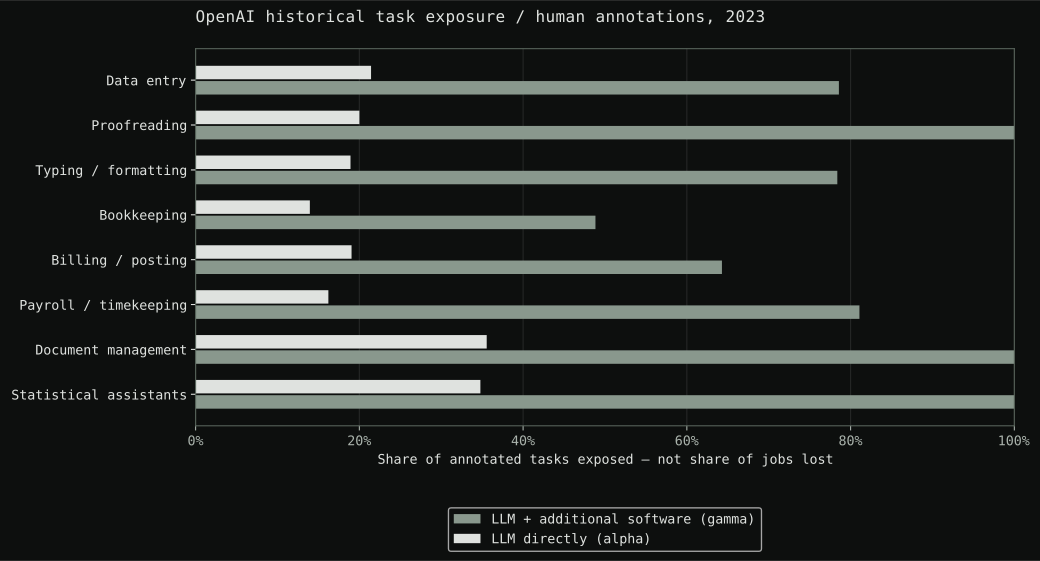
Read 100% correctly. All annotated tasks for proofreading, document management, and statistical assistants are exposed under the human-rated expanded measure. That means potential time reduction across the task list. It does not mean every task takes zero human time, every worker is replaceable, or adoption is guaranteed. These are historical 2023 annotations, not a fresh October 2026 capability test. OpenAI's published data and definitions.
GDPval adds tests of actual work deliverables across 44 occupations. A good deliverable is stronger evidence than a plausible demo. It still doesn't establish unattended operation of the entire job, including gathering context, dealing with exceptions, and taking responsibility.
The shortlist
The strongest AI candidates are structured data entry, mechanical proofreading, document conversion, and routine transaction processing. The strongest physical candidates are standardized packing and repeated material movement in engineered environments. Those are the first places I'd demand a serious substitution-cost comparison.
The table distinguishes a candidate for replacing routine labor from a machine that only removes one slice of a broader job. The verdicts are my analysis; the wages, employment counts, and historical exposure annotations are sourced. None is a probability of job loss.
22 roles. Open a role for the conditions and remaining human work.
| Occupation / core task / conditions | Assessment | Employees | Mean wage / h |
|---|---|---|---|
Bookkeeping, Accounting, and Auditing Clerks43-3031.00 · AI Machine does: Routine transaction coding and reconciliation Still human: Investigate exceptions, manage controls, close books Required: Stable ledger rules; reconciled output; accountable approval retained Evidence: OpenAI 2026 names some bookkeeping roles; whole occupation is broader | First shortlist | 1,373,680 | $25.75 |
Data Entry Keyers43-9021.00 · AI Machine does: Structured data entry and field validation Still human: Resolve illegible records, reconcile conflicting sources, approve exceptions Required: Clean digital inputs; validated write access; audit trail Evidence: OpenAI 2026 names data-entry clerks; actual integration economics remain site-specific | First shortlist | 127,080 | $20.82 |
Proofreaders and Copy Markers43-9081.00 · AI Machine does: Mechanical proofreading against a style sheet Still human: Resolve ambiguity, check meaning, approve publication Required: Rules are explicit; factual and legal review priced separately Evidence: OpenAI 2026 names proofreaders; 2023 human gamma = 100% is task exposure, not job loss | First shortlist | 4,580 | $26.35 |
Word Processors and Typists43-9022.00 · AI Machine does: Typing, formatting, and document conversion Still human: Handle malformed documents and sensitive records Required: Templates and acceptance tests cover the document types Evidence: Task-based inference from O*NET and OpenAI 2023 annotations | First shortlist | 35,010 | $24.58 |
Packers and Packagers, Hand53-7064.00 · Robotics Machine does: Standardized packing, sealing, and labeling Still human: Replenish consumables; clear jams; handle irregular or fragile items Required: Stable product mix; enough throughput to amortize a complete cell Evidence: Anthropic September 2026 modeled cost comparison identifies packers near parity; not audited plant savings | First shortlist | 559,820 | $18.05 |
Billing and Posting Clerks43-3021.00 · AI Machine does: Invoice extraction, matching, and posting Still human: Resolve disputes and approve unusual adjustments Required: Connected purchase orders, receipts, and accounting controls Evidence: Task-based inference; no observed whole-role replacement rate asserted | Conditional shortlist | 404,060 | $24.55 |
Document Management Specialists15-1299.03 · AI Machine does: Document classification, metadata extraction, and routing Still human: Set retention/access policies and resolve conflicting records Required: Permission boundaries and retrieval accuracy tested Evidence: O*NET tasks; OpenAI 2023 human gamma = 100%; employment not inherited from parent SOC | Conditional shortlist | — | — |
Medical Transcriptionists31-9094.00 · AI Machine does: Transcription and structured note formatting Still human: Verify clinical accuracy; correct dictation errors Required: No clinical judgment delegated; protected-data controls and verification priced Evidence: Task-based inference for transcription only; clinical care excluded | Conditional shortlist | 41,550 | $20.05 |
Order Clerks43-4151.00 · AI Machine does: Standardized order intake and processing Still human: Negotiate substitutions and resolve unusual customer cases Required: Only transactional intake; relationship sales excluded Evidence: Task-based inference for standardized back-office work only | Conditional shortlist | 75,200 | $23.19 |
Payroll and Timekeeping Clerks43-3051.00 · AI Machine does: Routine payroll calculation and time-sheet checking Still human: Interpret unusual employment rules and approve payment Required: Validated rules engine and integrations; human sign-off cost included Evidence: Task-based inference; automation includes conventional payroll software | Conditional shortlist | 153,140 | $28.67 |
Prepress Technicians and Workers51-5111.00 · AI Machine does: Template preflight, layout checking, and file preparation Still human: Resolve unusual print problems and approve final production Required: Standard templates and machine-verifiable print specifications Evidence: Task-based inference; custom design work excluded | Conditional shortlist | 23,840 | $24.43 |
Statistical Assistants43-9111.00 · AI Machine does: Recurring tables, data cleaning, and standard summaries Still human: Validate data definitions and investigate anomalies Required: Repeatable analysis; reproducible calculations; checked source data Evidence: O*NET tasks; OpenAI 2023 human gamma = 100% | Conditional shortlist | 4,710 | $26.75 |
Industrial Truck and Tractor Operators53-7051.00 · Robotics Machine does: Repeated pallet transport on mapped routes Still human: Handle damaged pallets, blocked routes, and nonstandard loads Required: Predictable routes; certified safety; intervention and fleet costs measured Evidence: Task-based inference supported by commercial warehouse mobile robots; not all forklift duties | Conditional shortlist | 774,420 | $23.25 |
Inspectors, Testers, Sorters, Samplers, and Weighers51-9061.00 · Robotics Machine does: Fixed visual/dimensional checks on a production line Still human: Analyze novel defects and disposition failed product Required: Stable defect taxonomy; false accepts/rejects measured at production speed Evidence: Task-based inference; physical inspection may use cameras and fixtures, not humanoids | Conditional shortlist | 597,370 | $25.70 |
Machine Feeders and Offbearers53-7063.00 · Robotics Machine does: Repeated loading/unloading of a fixed machine Still human: Clear faults, change fixtures, inspect unusual materials Required: Standard part geometry and a stable production cell Evidence: Task-based inference from O*NET; cost requires an installed-cell quote | Conditional shortlist | 42,330 | $20.99 |
Mail Clerks and Mail Machine Operators, Except Postal Service43-9051.00 · Robotics Machine does: Mail sorting, scanning, and standardized internal routing Still human: Handle irregular packages, sensitive items, and address exceptions Required: Sufficient centralized volume and machine-readable destinations Evidence: Task-based inference; includes established sorting automation | Conditional shortlist | 55,230 | $20.03 |
Cashiers41-2011.00 · Process automation Machine does: Scanning and payment in standardized checkout lanes Still human: Age checks, accessibility support, theft, returns, and exceptions Required: Measure shrink, intervention, and customer time; bagging may stay human/customer Evidence: BLS describes self-service checkout; this transfers work to customers and is not automatically robotics | Constrained task only | 3,089,410 | $15.95 |
Cooks, Fast Food35-2011.00 · Robotics Machine does: High-volume repetitive fry-station operations Still human: Load supplies, finish food, clean equipment, handle exceptions Required: High station utilization and measured labor removal across shifts Evidence: Miso 2025 launch advertised $5,400/month; not an all-in 2026 quote | Constrained task only | 641,070 | $15.57 |
Heavy and Tractor-Trailer Truck Drivers53-3032.00 · Robotics Machine does: Hub-to-hub highway driving on validated routes Still human: First/last mile, loading, inspections, roadside events Required: Approved routes and weather; fleet support included Evidence: Aurora October 2026 reports 500,000 driverless miles; target fleets are not delivered fleets | Constrained task only | 2,062,040 | $28.71 |
Janitors and Cleaners, Except Maids and Housekeeping Cleaners37-2011.00 · Robotics Machine does: Large-area floor scrubbing on repeatable routes Still human: Clean bathrooms, stairs, spills, edges, and cluttered areas Required: Large accessible floor area; measured cleaning quality and rescue time Evidence: Task-based inference; a scrubber is not a complete janitorial replacement | Constrained task only | 2,209,760 | $18.64 |
Stockers and Order Fillers53-7065.00 · Robotics Machine does: Inventory scanning and standardized replenishment Still human: Stock irregular goods, rotate dates, handle spills and customer interruptions Required: Scanning is separate from stocking; replenishment limited to engineered fixtures Evidence: Simbe scans shelves; FamilyMart/Telexistence announced specialized drink replenishment | Constrained task only | 2,833,810 | $19.01 |
Taxi Drivers53-3054.00 · Robotics Machine does: Driving on approved routes inside an operating domain Still human: Fleet service, remote assistance, accessibility needs, and incidents Required: Authorized operating domain; all-in cost per paid mile beats human service Evidence: Robotaxi service is commercial; no national driver-replacement rate inferred | Constrained task only | 41,050 | $24.01 |
No matching roles.
Employment is May 2025 U.S. wage-and-salary employment, not job openings or predicted losses. Mean hourly wages are straight-time pay, not total employer cost. A dash means the exact occupation title wasn't matched to a published wage row; I haven't borrowed a parent occupation's pay. BLS release and technical notes.
Stocking shelves is several different problems
Finding an empty shelf, fetching a case, opening it, placing the product, rotating dates, and clearing the packaging are different tasks. A system that solves one doesn't necessarily solve the others.
Simbe's Tally scans shelves and reports inventory conditions. It doesn't establish automated replenishment. FamilyMart and Telexistence announced specialized drink-replenishment robots for a 300-store rollout in 2022. That's evidence for stocking in an engineered fixture, not proof of a machine that can handle every aisle in a grocery store. Simbe FAQ, joint deployment announcement.
So yes, some shelf stocking can be robot work. The question is whether enough of a particular store's work fits the system, at a cost that actually removes paid labor. A robot that handles drinks while the employee handles everything else may improve availability without eliminating a shift.
Checkout has another wrinkle. Self-checkout transfers scanning and often bagging to the customer. That is process redesign; it doesn't require a humanoid. Count intervention, shrink, accessibility support, and customer acceptance before calling the payroll difference a clean saving. BLS expects cashier employment to decline 6% over 2025–35, but still projects substantial replacement openings. That is a decade-long employment projection, not a 2028 automation deadline. BLS cashier outlook.
What does the robot have to beat?
Compare total annual system cost with the cost of the human-equivalent output it successfully delivers. Count installation, financing, maintenance, software, energy, insurance, site changes, human supervision, and recovery from failures. Don't count maintenance twice if a service contract already includes it.
annual capital charge = installed cost × capital recovery factor
      human-equivalent hours = scheduled hours × useful utilization
                              × uptime × accepted-output fraction
                              × speed relative to a human
      cost per human-equivalent hour = total annual cost / those hours
Utilization excludes time with no eligible work. Uptime is availability during those useful periods. Accepted-output fraction excludes unusable results. Relative speed is measured while attempting the work. Measure them separately so the same delay or failure isn't deducted twice.
Here's an illustration, not a robot quote: $100,000 hardware, $30,000 integration, five years of life, and an 8% capital charge. Add $27,000 a year for maintenance, software, energy, site costs, and paid human help. Annual system cost is about $59,560.
At 4,000 scheduled hours, 65% useful utilization, 90% uptime, 95% accepted output, and 80% of human speed, that buys about 1,778 human-equivalent hours: $33.49 an hour. At 6,000 scheduled hours with the same performance, it falls to $22.33. The hypothetical robot hasn't improved. The site found more useful work for it.
A stocker's national mean wage is $19.01 an hour. Using an illustrative 70% wage share of total compensation gives $27.16 an hour in compensation. That makes the first configuration lose and the second potentially win—before checking whether the saved hours can be consolidated into fewer paid shifts.
The 70% proxy comes from the private-industry average in June 2026. It is not a measured benefit load for every stocker or state; part-time, union, and public-sector arrangements differ. Replace it with the actual employer's costs. BLS compensation data.
Change the assumptions / no vendor quote implied
Annual system cost $59,559
Human-equivalent hours 1,778
System cost / equivalent hour $33.49
Human compensation proxy / hour $27.16
Margin per equivalent hour −$6.33
System costs more under these assumptions.
Annual operating-cost default: $8k maintenance, $6k software, $1k energy, $4k site/insurance, $8k paid human assistance. Illustrative amounts. The comparison values output; it does not prove saved hours can remove a paid shift. Residual staffing stays outside the saving.
One public price, and what it doesn't tell us
Miso advertised its Flippy fry station at $5,400 a month in January 2025, with no upfront equipment cost. This is a dated advertised rental, not a verified all-in October 2026 quote. Manufacturer announcement.
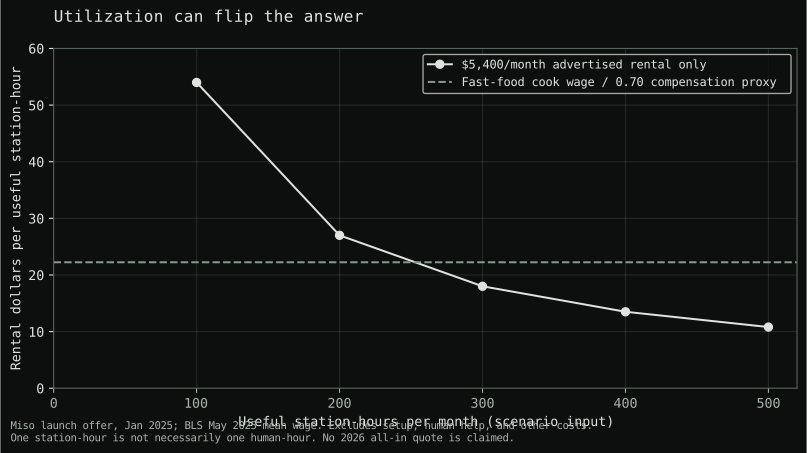
At 200 useful station-hours, rental alone costs $27 an hour. At 400 hours, $13.50. But an hour of fry-station operation isn't necessarily an hour of human labor avoided. Loading, finishing, cleaning, downtime, and supervision can leave much of the staffing in place.
This is why a busy chain location can have a different answer from a quiet restaurant. Get a current quote and measure the before-and-after roster. A vendor's claimed throughput isn't a payroll reduction.
State lines can change the answer
Use the wage for that occupation in that labor market, the employer's benefits, and the applicable shift schedule. The national average is a starting point.
California's statewide minimum is $16.90 in 2026. Texas's general minimum is $7.25; New York's is $17 in New York City, Long Island, and Westchester, and $16 elsewhere. Local and sector-specific rules can differ. These are legal floors, not typical wages for the roles in this article. California DIR, U.S. DOL state table, New York DOL.
At an illustrative $25 per successful human-equivalent robot hour and a 70% wage share, parity occurs at a $17.50 human wage. A hypothetical $15 wage implies $21.43 compensation; $22 implies $31.43. The same machine loses the first comparison and wins the second. These are sensitivity inputs, not measured state occupational wages.
This analysis assumes no new restriction specifically blocking substitution. Existing safety, licensing, employment, and operating-domain requirements still apply. “No new ban” doesn't mean no rules.
For AI, the model bill may be the small part
The equivalent comparison is cost per accepted output, including context gathering, retries, tools, review, integration, and errors.
Anthropic lists Sonnet 5.5 at $2 per million input tokens and $10 per million output tokens. At those rates, a hypothetical run using 20,000 input tokens and 2,000 output tokens costs $0.06 in base inference. Five such runs cost $0.30. This excludes caching variations, extra tool charges, and other billing details. Provider pricing, checked October 27, 2026.
Suppose a person previously spent 15 minutes on the task at $40 an hour fully loaded: $10. Add five model runs, three minutes of review at $50 an hour, $1 allocated integration/operations, and $0.50 expected correction cost. Automated-path cost is $4.30; saving is $5.70 per accepted result. All task volumes, times, and non-token costs in this example are assumptions.
At 100,000 accepted results a year, that's $570,000 before one-time migration costs. If review rises to ten minutes, the saving becomes a loss of about $0.13 a result. If the work can't be safely checked that quickly, the cheap token bill doesn't rescue it.
A customer-facing conversation isn't automatically relationship work, but neither is it automatically disposable. This article includes standardized order processing only. It doesn't make a replacement claim for relationship sales or service whose value depends on a person.
How much employment could be displaced?
Start with a defensible denominator. These six distinct occupations—data entry, proofreading, bookkeeping, payroll, billing, and hand packing—account for 2,622,360 wage-and-salary employees in the May 2025 estimates. That's the population used below. It isn't the number of people who will lose work.
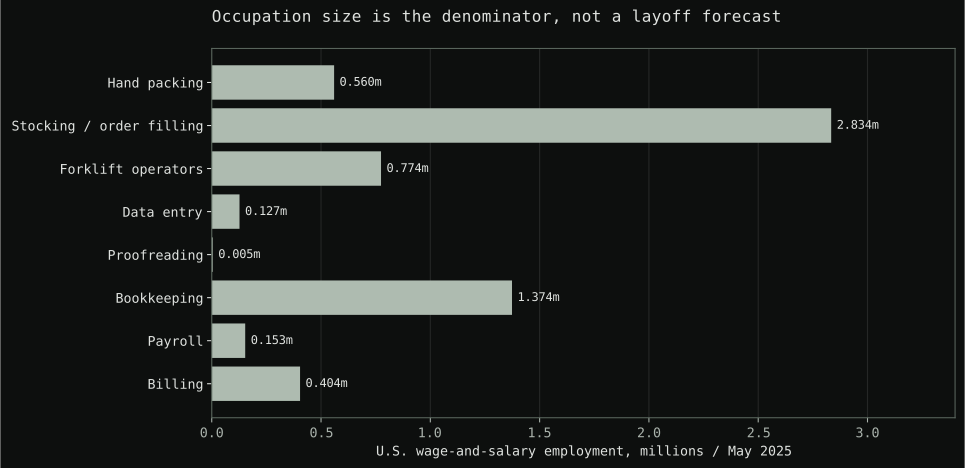
Time saved becomes a staffing reduction only when firms adopt, tasks actually get faster after oversight, and the remaining work can be reorganized. Demand can absorb the capacity. Attrition can replace layoffs. Some savings sit below the minimum staffing needed to cover a shift.
capacity freed = employment × adoption × task share × net time saved
      position equivalents = capacity freed × share captured as fewer positions
| Scenario | Adoption | Task share | Net time saved on those tasks | Captured as fewer positions | Position equivalents |
|---|---|---|---|---|---|
| Limited rollout | 10% | 20% | 30% | 25% | 3,934 |
| Broad rollout | 25% | 40% | 50% | 50% | 65,559 |
| Fast rollout | 50% | 60% | 70% | 75% | 413,022 |
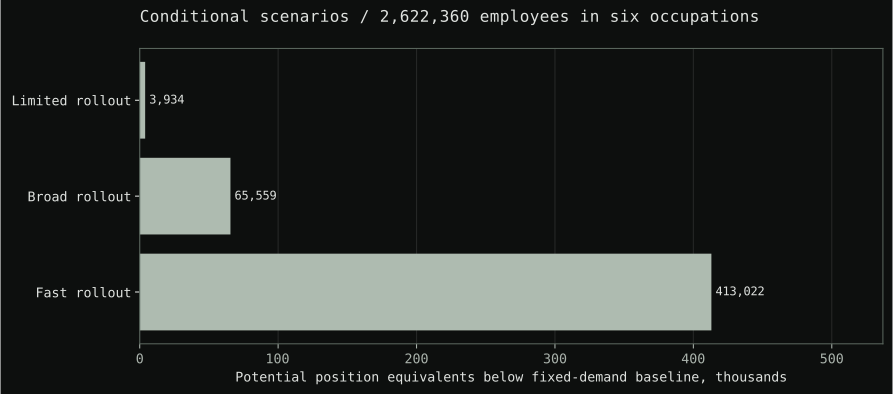
The calculation assumes equal hours per employee because OEWS counts people, not occupation-specific full-time equivalents. “Position equivalents” describes labor capacity below a fixed-demand baseline. It doesn't identify actual people, forecast unemployment, or include new jobs elsewhere. The scenario inputs are deliberately visible; they aren't estimated adoption rates.
For the monthly chart, the fast case is the pressure scenario: repeat cuts and hiring compression where firms can document savings. Don't extrapolate its adoption rate to the entire economy.
The next 24 months
The technology already exists for parts of this work. The dates below are my deployment scenario, not claimed invention dates. The gates are measurable: accepted output, useful hours, intervention, net savings, and an actual reduction in required staffing. If those gates fail, move the window.
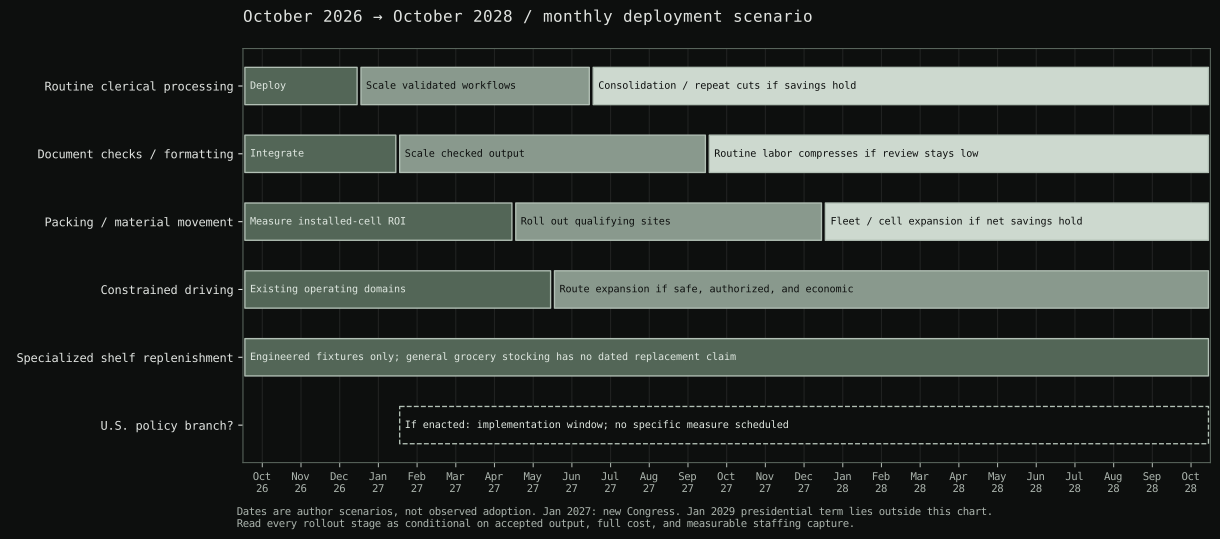
Routine digital workflows can spread without manufacturing a fleet. Physical rollout needs capital, installation, spares, service staff, and a useful site. Aurora reports over 500,000 driverless miles as of its October 2026 investor discussion; its 2030 fleet vision is a target, not vehicles already operating. Agility's October 26 expansion announcement reports over 100,000 totes moved at the original GXO site; it doesn't disclose a universally applicable labor-replacement cost. Aurora, Agility/GXO.
A September 2026 Anthropic study models robot capability and cost separately. It estimates far more technically exposed work than cost-competitive work: 34% of working time versus 0.3% under its cost model. Those are modeled estimates, partly constructed using Claude and web research, not audited deployment totals. It identifies packing as an early economic candidate. That supports narrowing the physical shortlist; it does not establish a universal replacement date. Robotics study and methodology.
Policy is a branch. A new Congress starts in January 2027. A law could take effect during 2027–28 if enacted; no particular restriction is scheduled here. The presidential term following the 2028 election starts January 20, 2029, outside this chart, with implementation potentially later. Congress timing, presidential terms.
What would make me change the list?
Show me successful output per paid hour, the full operating bill, and the staffing before and after. Track failed tasks, human rescue, returns, safety incidents, and rehiring. A site can automate more work and still employ more people if demand expands. A company can cut people and still have an automation project that didn't work.
My bet is concentrated: routine digital processing goes first; standardized physical work follows where the utilization and installed-system economics work. General shelf stocking is a harder claim. Necessary human relationships aren't the target of this article.
The question isn't whether a machine looks impressive. It's whether the business can stop paying for the same labor and still deliver.
Data and method
This is a U.S. analysis as of October 27, 2026. The source catalogue contains 1,016 O*NET profiles in release 31.0; the article evaluates 22 selected roles. The full catalogue is provided as a coverage ledger, not 1,016 individually researched replacement verdicts. Excluded occupations receive no verdict.
Wage matching uses exact normalized titles only, prefers the detailed BLS row where labels repeat, and leaves unmatched values empty. O*NET specializations overlap broader occupations: don't sum the full ledger. OEWS excludes self-employment, much agriculture, private household employment, and military occupations, so this isn't a census of every job on Earth.
Shortlist CSV · Full occupation ledger · Scenario inputs · Source manifest and hashes. ONET data are used under CC BY 4.0; occupation descriptions are from the National Center for ONET Development. The OpenAI annotation repository uses the MIT license.
have fun dont die